A decoder built from real radio
Instead of relying on one rigid DSP path, ACARSd used multiple decoder passes, empirical code tables, CRC validation and adaptive table ordering to extract messages from imperfect analog audio.
Before crowd-sourced aircraft tracking became mainstream, ACARSd connected distributed radio receivers over the Internet, shared live ACARS traffic, enriched it with databases and let remote clients watch aircraft activity from stations around the world.
libadsb-reader is now freely available. The library gives Linux applications direct USB access to the Kinetic Avionics SBS-1 and the AirNav Systems RadarBox V1 / RB-1, without needing the Windows software.
Bring your receiver back into use with the included command-line reader, or build your own application around the common C API.
adsb-radar turns the library's live data into a Linux desktop radar with smooth aircraft movement, flight trails, searchable aircraft details and optional airline and route information.
Already packed with features, and still growing: many more are on the way.
The aviation project ended, but the pattern did not. KjM is still a programmer at INLINE, with Dr. Armin Zundel still both boss and close friend. Plumeria became a specialist business — and eventually a nearly 300-page book — while years of travelling to Bali grew into another business around Balinese products.
The new epilogue also looks back at the people from the ACARSd years: some friendships never broke, some contacts became quieter, and rebuilding the museum has unexpectedly brought many of them close again.
The restored database can now be searched directly by aircraft registration, flight number, six-character ICAO24 address and date range. Aircraft details are enriched from the recovered reference database while the original historical message records remain untouched.
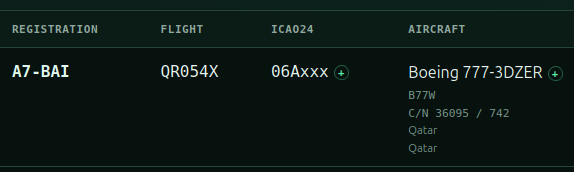
The museum now includes a dedicated ICAO24 Aircraft Lookup. Enter a six-character Mode-S hexadecimal address and resolve it against the recovered historical aircraft database — including registrations, types, construction numbers and operator data that may no longer appear in current fleet lists.
One of the rediscovered mappings links the Mode-S address 47161A to Malév Boeing 737 HA-LOA. The associated aircraft record identifies a Boeing 737-7Q8, construction number 28254.
For anyone who spent nights watching ACARS traffic scroll across a terminal, this sequence was instantly familiar: a leading *, two SYN characters and SOH — Start of Header. Before registrations, flight numbers and message text appeared, this was the little signature that said a real ACARS frame was beginning.
This site preserves the history and engineering of ACARSd. Most of it is reconstructed from original source code, CVS/RCS history, website archives and contemporary project notes. Since 30 August 2026, one small local receiver has also been allowed back into the museum.
Instead of relying on one rigid DSP path, ACARSd used multiple decoder passes, empirical code tables, CRC validation and adaptive table ordering to extract messages from imperfect analog audio.
A station could decode locally and serve live traffic to remote clients. Public server lists, web access and central reporting turned isolated scanners into a distributed community network.
Aircraft, airline, routing, position, fleet and image data were combined with decoded traffic. Later work also bridged into Mode-S/SBS data through the HomeRadar libraries.
That goal was written down while the actual decoder still did not work. It is why ACARSd was never merely a sound-card utility: the network and database were part of the idea from the beginning.
The first successful live decode was HA-LOC, a new Malév Boeing 737 on its delivery flight.
Read the reconstructed story →
ACARS is not ADS-B and ACARSd was not a continuous radar in the modern sense. But the core Internet model was strikingly familiar: many geographically separated receivers, shared live data, remote clients, discovery of public stations and a central historical data service.
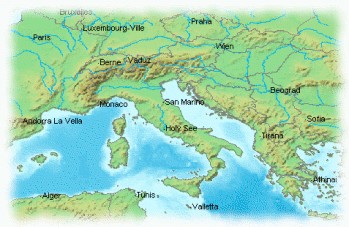
An old RTL-SDR stick, a Raspberry Pi 5 and readsb have turned one corner of the museum back into an actual receiving station. The new page contains only aircraft heard by the local antenna in Balatonszárszó — no external tracking network.
Search today's local receiver data → Open the full live radar →
Every fifteen minutes the station contributes its latest locally received aircraft snapshots to the restored ACARSd database.
A failing ext3 server still contained 1,729,775 binary client uploads that had never reached the later database-processing stage. In 2026 the files were rescued in blocks, decoded from the original ACARSd collection structure and checked individually.
1,723,977 uploads decoded successfully — 99.6648% — producing 72,788,180 recovered ACARS records. The WORLD ACARS Report import is now complete as well. A verified database count on 30 August 2026 returned 114,328,158 searchable message rows. The public museum search is online, and the restored local receiver is adding new 2026 observations again.
After the old server was temporarily reachable again, an ACARSd 1.70RC3 installation uploaded a real collection on 26 August 2026. Other surviving 1.65Win clients also began asking the original lookup endpoints for aircraft and flight information.
A recovered 23-page ACARSd manual documents the early decoder/server in remarkable detail. The later libhomeradar archive goes one step further: sixteen C examples show other developers how to connect receivers, handle events, enrich contacts, filter aircraft, calculate distance and feed network services.
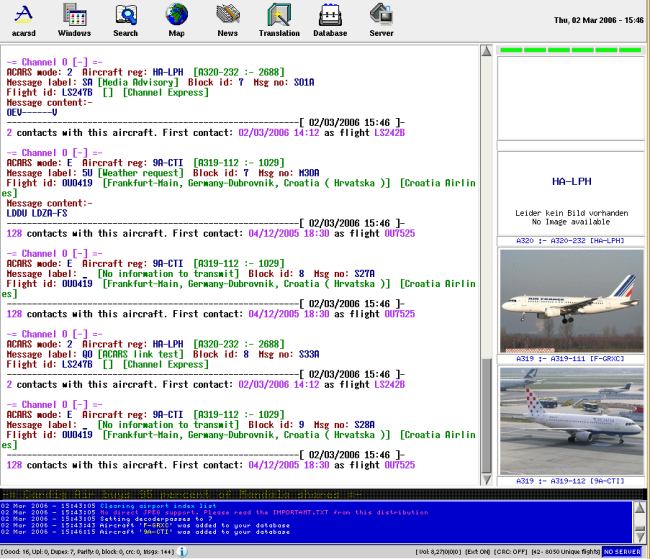
The V19 exhibit also adds nine ACARSd screenshots from 2 March 2006, including the GUI, Linux console, statistics and the hidden games.
Recovered CVS sources identify the 2010 commercial project as ATLAS for FlightGlobal. Built in Adobe Flex/Flash on Google Maps, it consumed community SBS/Mode-S feeds and already rendered aircraft by type and airline colours.
Its icon system contained distinct silhouettes for the Boeing 747, Airbus A380, A340, MD-11, 767, A320/737 family, regional aircraft and later the 757, 787 and A350. Body, wings, tail and engines could be coloured separately for an airline.


EUclaim supplied ACARSd with flight-number translation data; in return it received the live ACARS stream. A public court record later documents an EUclaim case against Martinair over flight MP815 to Canada, delayed by more than 24 hours — a remarkable match to a case remembered from the ACARSd years.
A 2010 European Commission study independently records that EUclaim used ADS-B/ACARS transmissions among its evidence sources.
Former users, server operators, testers and contributors are invited to add their memories to the museum.
The restored archive revealed a forgotten early experiment: ACARS LIVE, a browser-based live client from 2003 that pulled ACARS traffic through a small proxy daemon and even fetched aircraft images from FYSB. In September 2003 a formal developer API already exposed structured network operations, and the independent Java client JACARS later connected to the same network.
*<SYN><SYN><SOH>
        ↓
     ACARSd
        ↓
  TCP network / API
   ↙      ↓       ↘
Tcl/Tk  Browser   Java
Client  ACARS LIVE JACARS
        ↓
FYSB imagesNewly recovered CVS trees show the later evolution with unusual clarity: libacarsd2 turned ACARSd technology into a reusable library; mACARS became a small Windows front-end; winsend2 merged ACARS, SBS-1 and RadarBox data; and FlightShare2 distilled that large toolkit into the deliberately simple feeder FlightGlobal wanted for ATLAS.
Positions were only one small part of the system. The recovered archive contains oceanic clearances, routes, engine and performance data, maintenance faults, diversions, dispatch traffic and medical requests — as well as proprietary payloads that remained unreadable even after the ACARS frame was correctly decoded.
Historical ACARSd releases, Windows builds, ClientNG, ACARSdClient, libraries and support files are available again under the original /download/ path.
Claims on this site are deliberately separated into contemporary documentation, facts visible in the source/CVS history, and memories supplied by the original author decades later. Where a date or technical detail is uncertain, it is marked as such.
The original project story documents the accidental ANAD report, the scanner odyssey, the first decoder, the ANAD comparison, CRC support and the Windows port.
RCS/CVS files preserve the actual multi-pass decoder, code tables, CRC routines, FFT experiments and revision history after the decoder was separated into a library.
Original server pages, API documentation, release notes, public database tools and historical web content reveal how broad the project had become.
Years after ACARSd began as a hobby decoder, its historical records and flight data were sometimes consulted in the aftermath of major aviation events. These recollections are preserved with a strict distinction between memory and independently established facts.