The milestone that was still missing on 31 August is complete: a real radio receiver is feeding the resurrected soundcard decoder, and genuine aircraft transmissions are appearing in ACARSd again.
Real ACARS messages — not test data.
On 1 September 2026 the restored decoder successfully received live ACARS traffic from aircraft over Hungary. The first successful reception of the resurrection was followed by maintenance/warning reports, position reports and multi-block data messages.
ACARS mode: 2
Aircraft reg: TC-SPF
Message label: 16
Flight number: XQ022G

160559,+37998,1705,11440,N 47.3513,E 17.7736,SXS22G
The same session also demonstrated that historical validation paths are still active: ACARSd detected parity, block and FCB/CRC problems instead of simply accepting damaged traffic.
Good: 27 Dupes: 5 Parity: 15 Block: 6 CRC: 1 Msgs: 36
These figures came from an early test with the small antenna still in a temporary, low position. Reception quality therefore has considerable room to improve.
The 2000s network client talks to the 2026 server.
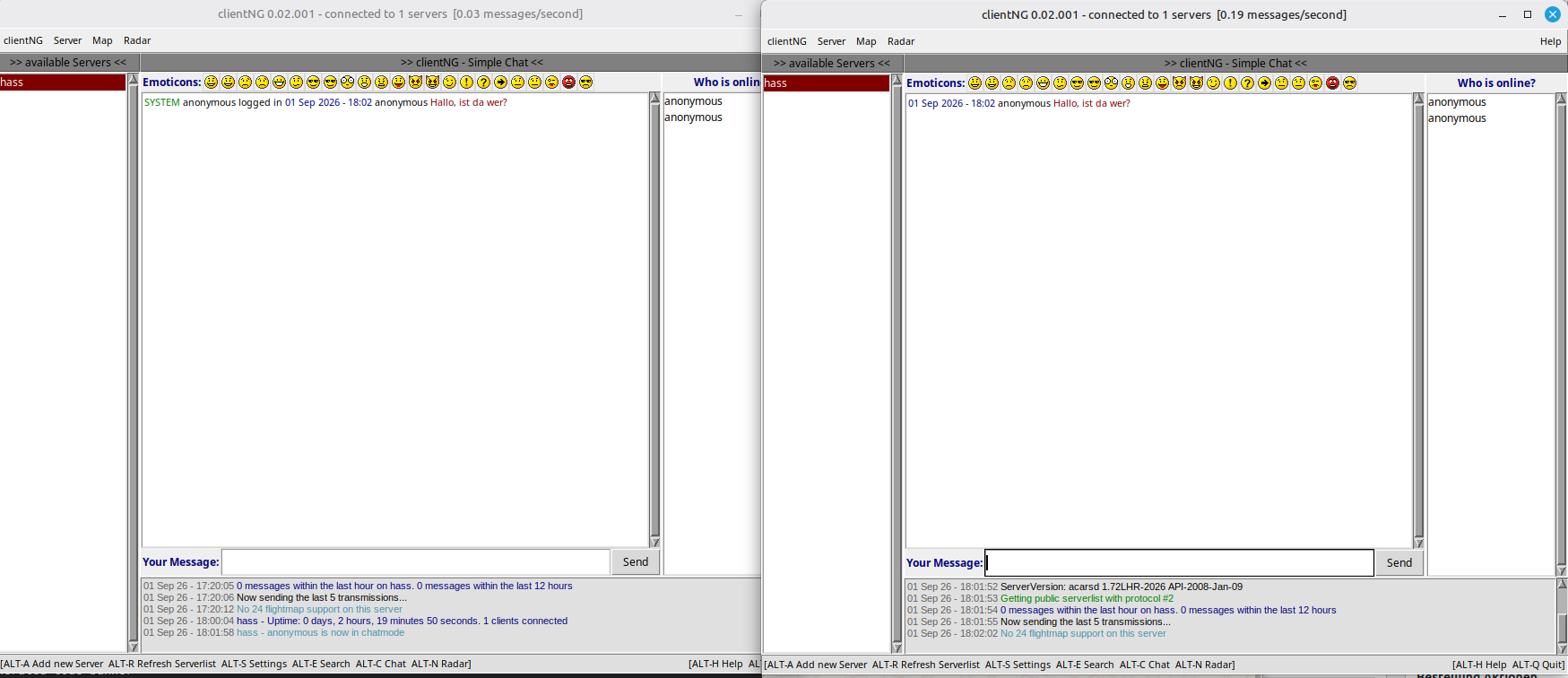
The original clientNG 0.02.001 now builds and runs again. It connects to ACARSd 1.72LHR-2026, reads the server protocol, retrieves recent transmissions, displays server information and even supports its original internal chat.
A four-byte assumption survived for twenty years.
One of the most revealing clientNG crashes was a modern glibc buffer-overflow abort inside the image/download code. The cause was not a damaged ACARS message but a classic LP64 portability bug.
historical Linux:
#define DWORD long

32-bit Linux: sizeof(long) == 4
x86-64 Linux: sizeof(long) == 8
The old binary protocol expected a DWORD to remain exactly 32 bits. On x86-64, long became eight bytes while surrounding offsets still advanced by four. Defining DWORD as a fixed 32-bit value restored the original data layout and clientNG immediately continued running.
mktclapp, Tktable and a forgotten geometry bug.
The client resurrection uncovered three independent compatibility layers. The historic mktclapp 3.11 generator had to preserve Tcl's original source command and delegate modern forms such as source -encoding to Tcl itself. The original Tktable 2.8 source from 2002 was rebuilt as a native 64-bit library against Tcl/Tk 8.6. Finally, an old radar window attempted to manage the same canvas with both grid and pack; removing the redundant grid call allowed the GUI to continue.
mktclapp 3.11  → embedded Tcl works again
Tktable 2.8     → native ELF64 x86-64 build
clientradar.tcl → one geometry manager per parent
DWORD           → fixed 32-bit wire/data semantics
The original acarsdgui plugin system still works.
The historic pluginpack utility successfully rebuilt the original .aplg packages. ACARSdGUI then loaded them normally, including FlightGrid and the IconServer plugin.
Plugin 'FlightGrid Creator 1.20' successfully loaded
Plugin 'Fetch icons from different servers V1.12b' successfully loaded
Server successfully changed!
The IconServer plugin restores the old menu that could select between several contemporary aircraft-picture databases. Most of those external services have changed or disappeared, so image retrieval is now a separate historical-infrastructure problem rather than a decoder or GUI problem.
The core system is alive again.
Decoder, ALSA audio capture, Tcl/Tk GUI, client/server protocol, clientNG, database tools, plugin packaging and live ACARS reception have all been demonstrated on a modern Linux system. What remains is no longer the question of whether ACARSd can be resurrected. It can. The remaining work is preservation, cleanup, reproducible builds and replacement or emulation of external Internet services that vanished long ago.